A blog about the activities of the Museum Career Internship Program, a partnership between The American Folk Art Museum and LaGuardia Community College. Support for this program is provided by Richard and Laura Parsons, the Schaffner Family Foundation, Jane and Gerald Katcher, Donald and Rachel Strauber, and the LaGuardia Community College Foundation.
Hi, my name is Jade and I am currently a Fine Arts student in my sophomore year at LaGuardia Community College. My pronouns are she/her/hers and I am currently 21 years old living in Queens, NY. In my free time, I love to listen to music, watch movies and TV shows, or play with my cat Calypso and my dog Chui.
I remember my passion for art developed after I woke up on a Saturday morning when I was 5 and saw a rerun episode of Bob Ross’s show on PBS. I instantly fell in love with art while watching his program. His optimism and encouragement really made me feel like I could become a great artist if I practiced enough. I owe my love and passion for art to him, and every time I struggle with a piece I always remember his encouraging words to keep going and to trust the process.
Still life painting by Jade Piza-Ortiz
When I first heard about the Museum Career Internship Program, I was instantly drawn in by the strong community that they’ve built in the previous years with their interns. Meeting Natalie and the rest of my team really made me feel welcomed to be working as a valued member of the museum. This opportunity is a perfect fit for me because I can grow my education in art and learn more about about the business aspects of art and curating.
During the pandemic I took the time to work on my skills with digital design using Adobe. It has given me the time to hone my skills and develop my understanding with using different mediums and exploring different concepts of art. I hope that in the future I can build my own business with graphic design and create my own line of street wear for everyone. Nothing would make me happier than seeing people wear my designs on their clothing and appreciating the time and dedication I put into creating those graphic designs.
Hello, My name is Lester. I am currently a student at LaGuardia Community College and intern at AFAM . I grew up in New Jersey and Queens, NY. I have lived in over 10 different households and adjusted to different worlds and different people. With the constant change, I developed a habit of adapting as opposed to maintaining which ultimately created a dichotomy between balance and uncertainty. This has made life very interesting. I’ve learned that the world isn’t all black and white but shades in between. Within these shades of gray, the greatest moments happen–not being bound by any biases and able to view and understand the world in a different light.
I’ve been creatively active for as long as I can remember, from drawing doodles instead of taking notes in school, to writing comic books on notebook paper and selling them for lunch money. To me, art is a feeling just waiting to convey itself. These feelings can resonate between worlds that wouldn’t otherwise communicate. However, I never thought I would be pursuing animating and illustration until recent years. I did construction for two years and became a licensed carpenter which was completely off track in regards to my goals in life. My major prior to fine arts was psychology as I thought being a therapist was also something that I would enjoy. All just to realize I was avoiding something that was very evident, my passion for drawing. These were all stepping stones nonetheless. I am excited for this internship and more than appreciative for this opportunity. I feel like it’ll be more than just a learning experience and more so a chance to grow personally and professionally.
A screenshot from an animation hand drawn in a black and white contrast, 2020, Lester Fernandez
I jumped into the AFAM Internship blindly and fully without hesitation. I say blindly because I didn’t know much about what I would be learning and even less about the art world, but I am so intrigued with the idea of a cultural institution that champions the self-taught artists that didn’t attend prestigious colleges or have a pedigree that’s usually respected in the art world. This idea makes me feel included in a world that I feel far removed from. I was born and raised in NYC and the first time I went to the Met was in 2008 (I was born in 1976). Friends have asked me, “How is it possible that you’d never been there until you were in your 30s and you grew up in NYC?” I used to just shrug and say, “I didn’t really know about it.” I live in the greatest city in the world and museums like the Met or the Guggenheim or the Whitney were not even a blip on my radar. My idea of art was (and still is) graffiti, neighborhood murals, cartoons and eventually when I found punk rock as a teenager, outsider art stole my heart.
I used to say, “I love art. I hate artists.” I said this because the only artists I had ever met were snobby and pretentious, which turned me off to art. I didn’t understand anything about it other than what I saw on the surface (“a 5 year old can make that”). I was not taught how to really view a piece of work and find the hidden messages and secrets buried deep inside a piece of art that some stranger birthed and crafted to present to the rest of the humans walking the planet. I believe the need to create is inherent in all of us. It needs to be nurtured, but it’s there. Whether through writing, painting, sculpting, or dancing, it doesn’t matter the medium, we must make sense of the world somehow.
As I grew older, I learned to listen to my creative voice. First, I found writing, and then I found photography. I’m currently studying Commercial Photography at LaGuardia Community College and I am truly in love with it. At the age of 43 I finally allowed myself to pick up a paintbrush. During the Covid lockdown in 2020 I kept hearing this nagging voice inside my head telling me to paint. I made excuses: “I can’t even draw a straight line, I don’t know how, I suck at art, artists are pretentious, you don’t fit in,” but with so much time on our collective hands I threw caution to the wind and decided to try it. Art supply stores were closed so I improvised. I had a few left over quarts of paint and brushes from when my daughter was into crafting, and I went to the hardware store and picked up some small paint samples and 2 rolls of drop cloth for house painting. I came home, cut a huge 3×5 foot piece of drop cloth and just started painting. It looked terrible but I didn’t care. The feeling I got from making work is almost indescribable to me. I didn’t care if it wasn’t perfect or it didn’t look like I imagined it in my head or if anyone else understood what I was trying to make or not, it simply was a cathartic release that completely put me at peace. Art is a survival tool for me. That’s what I love about AFAM. All of the artists represented are/were doing that, creating just for the sake of creating.
Graff Tribute, Maylyn Iglesias
I’m only two weeks into my internship and so far I’ve learned about quilts and textiles and the artistry of weathervanes. The access to so many artists that I’ve never heard of is fantastic! I feel like I’ve been given a magic key that will open doors that I don’t even know exist. I’m looking forward to curating a final project and mostly I’m hoping to learn more about archiving and preserving artists work and learning how to get people interested in keeping this kind of work alive. I’m hoping to open a darkroom/digital media/arts community center when I “grow up” (ha). I feel like the education I receive through this internship will be invaluable and continue to push me forward to making that dream happen.
Hello! My name is Abigail Guzman, and I’m a sophomore at LaGuardia Community College majoring in Fine Arts. I was born in the Philippines and grew up on the coasts of Ecuador. Growing up I was exposed to nature and wildlife, and that is why I work part time as an animal assistant. In fact, my first college try was animal science, but the major was not meant for me because deep in my heart I knew I wanted a career in the art field. My goal as an art major is to learn how to express my deep thoughts into any artistic output and share the message of caring for nature. I plan to continue my education at the School of Visual Arts, and then get a master’s degree in art conservation and restoration. Animals and nature are the usual themes found in my drawings, and I also do my own interpretation of characters from literature. I don’t limit myself to drawings or paintings. When an idea sparks, I tend to use whatever I can grab first or whatever materials I have around that I see useful such as drinking straws and old newspaper. So, there are a variety of art pieces found in my portfolio, but my specialty is graphite and charcoal.
On occasion, I experiment with different materials to see if my crafting interests will expand. Sometimes I crochet for 2 months straight or make a series of mini furniture for my cats. This is why the internship at AFAM caught my attention, I had no idea that many crafting skills such as crochet, tapestry, woodcarving and even furniture were considered folk art. It was a big surprise for me because where I grew up, we only recognized cultural and indigenous works as folk art. At AFAM, I hope to learn how to curate an exhibition, learn to identify folk art pieces, and especially how to conserve them so that I can apply the knowledge and share it to my hometown. Another dream of mine is to establish art appreciation and build a museum in the Islands featuring not just traditional art, but works made by local crafters as well.
Mind in Crossroad, graphite on sketch paper
The internship began on September 13, and I already found myself in awe even if half of the meetings were virtual. It is very different when you study art through an internship compared to studying from books because I get to analyze the pieces up close and learn the history from people who are already familiar with them. Insights from the professionals and opinions from my fellow interns will help me understand how other people interpret the artwork. Some of my favorite works from the AFAM collection are the miniature pieces of furniture. They are fascinating because of the fine details the artists put into the design, especially the animals in Michael Rothloff’s Bed. I appreciate the fact that the artist created the necessary parts a life sized bed would have. If it wasn’t for the description next to the photos, I would have mistaken these as life sized. I’m sure if I saw them in person, I would be floored.
Bed; Michael Rothloff (1855–1930); Athens, Pennsylvania, United States; 1922; Fruitwood; 6 x 9 x 6 inches; Gift of Ralph Esmerian; Photo credit: Gavin AshworthMiniature Chair, Artist Unidentified; possibly Pennsylvania; 1860–1870; paint on wood, cane seat; 13 1/2 x 8 3/4 x 6 3/4 inches; Gift of the Historical Society of Early American Decoration
Hello AFAM multiverse! My name is Adrian and I am currently a student at LaGuardia. My interest in art started really early. I may have even started drawing before ever scribbling a word. I remember preferring paper, markers and watercolor sets over toys. I never thought of myself as an artist though, not until I was much older, and not until college. After a long recess, going back to college for a formal art education is my current adventure. For me, having this internship opportunity with AFAM makes all the challenges associated with a journey into the world of art making worthwhile. It feels like another piece of the puzzle that fits.
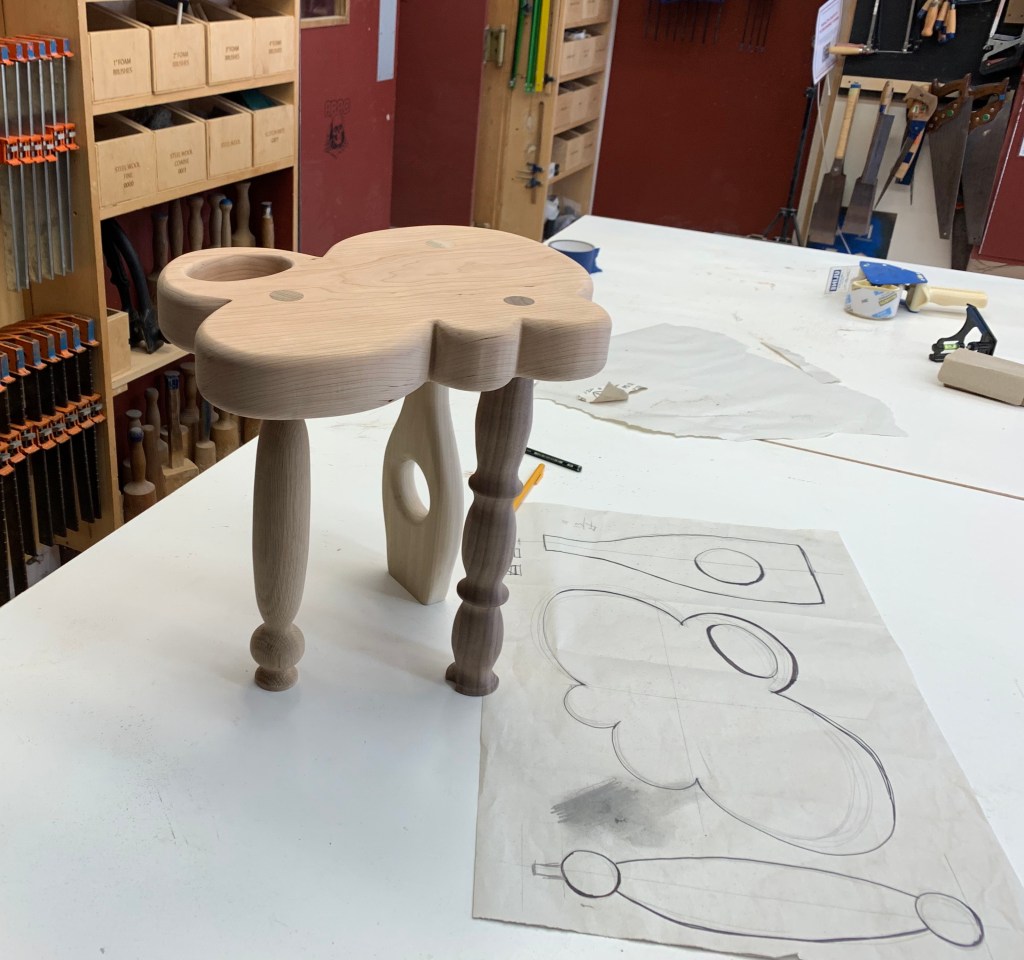
Over time my artistic interests have expanded to include craft and design. I am interested in how the spaces and objects we use daily come into being. Thus, my immediate goal after LaGuardia is to continue my education at Pratt Institute, studying Industrial Design. Most appealing, regarding the internship, is the ability to learn about the museum’s many handmade objects and the techniques and materials employed in their production. I like to ponder how earlier traditions of craft and design can guide my own art making.
Stool I made at a summer workshop at the Anderson Ranch Arts Center, Snowmass Village, Colorado, 2021
It has been really wonderful to meet my fellow interns and members of the AFAM family. My favorite intern experiences so far have been a visit to the museum to view “American Weathervanes: The Art of the Winds” and a visit to Nicelle Beauchene Gallery with Natalie and Persephone to view Mary Lee Bendolph’s captivating quilts. I look forward to the learning experiences this internship has to offer.
by Denisia M. Codrington, Adult Public Programs Intern
My experience with this internship at first was very uncertain, though I was optimistic. I had never done anything like it before, but felt with my extensive customer service/operations background I would be a great fit. Also, I love challenges. Well before we started working with a department, I attended any webinar from AFAM I could and developed a love for the community. Digital Drink + Draw was especially close to my heart. Being stuck inside like everyone else, I appreciated how relaxed the atmosphere was, and from the times I attended, I saw a lot of familiar faces. This level of community and engagement inspired me to apply for the Adult Public Programs internship, and I was elated when I was accepted.
During this internship, I took up the task of creating my own Digital Drink + Draw program, and for that I needed a solid foundation. I attended other webinar programs to observe examples of teaching art-making online. I attended sessions with organizations including the Frick and the Noguchi Museum. I studied the hosts and discussed weekly with Persephone Allen (Manager of Adult Public Programs) what I would have changed and what they did well. Not only that, I attended basically all the other AFAM programs, the NAEA Museum Education Pre-Conference, and many other educational programs. All of this was for the purpose of expanding my mindset, listening to other speakers, and observing how they engage with audiences.
During the AFAM programs I took images for the museum archives, helped to moderate the chat, and engaged with audiences. I also created an outreach sheet with fellow Education Department Intern Ava, where we organized 100+ contacts for a virtual reading with Asmaa Walton, founder of the Black Art Library. This event ended up being the top webinar for the month of February. From the very beginning, Persephone mentored me, established a solid game plan and guided me accordingly. She really is the most encouraging and understanding person. There were a few times I will admit I fell off task (being a double major while working and all), but I bounced back almost immediately.
When it came to the actual planning of the Digital Drink + Draw session, both Natalie Beall (Education Specialist) and Persephone supported me. I chose the theme “Inner Worlds + Alter Egos.” The session would be co-hosted by me and Natalie, with Persephone as the introductory narrator/collaborator. The kind of art I do is illustrative, and I have stories (not finished yet!) revolving around these plot points. The artists I chose were Minnie Evans, Howard Finster, and Mehrdad Rashidi. I attempted to gather research online, but admittedly it wasn’t enough. Through Persephone, I was able to visit the main office and do research, while talking to real people (Thank God): Regina Carra (Archivist) and Louise Masarof (Librarian). They were kind enough to prepare materials for me, which I dived right into. By the end of about four hours, I had all the information I could ever need and introduced myself to as many people as I could. I met Emily Gevalt (Curator of Folk Art) and Jason Busch (Director and CEO). Everyone was very pleasant, and I was just happy to talk to people in person again.
Denisia at the American Folk Art Museum, in front of a Minnie Evans painting (top)
The month of March all the way to May was a serious crackdown time. Natalie, Persephone, and I met a number of times; discussing material, references, drawing prompts, and artist biographies. I was grateful to have their support, as I got stuck a few times and tried not to be extra. I rehearsed twice, once with just us three, and later with my fellow interns. Everyone loved it, and it was engaging, which was all I could ask for. If you’re asking me, ‘Hey, were you nervous?’ I’d say yes, but not in the way you’d expect. I was used to talking to people in a formal setting for seven years and problem solving. My nervousness in that respect was long out the window. My only concern was that I would not be accepted by the crowd. Being an individual who is not a well-known artist or linked to other organizations, I worried that others would not be interested in what I had to say; or worse, that the regulars would leave. Luckily, my fears were unfounded. I nursed that beer, and the program went off with a hitch! Everyone was engaged, I was asked tons of questions, and people wrote about the way I worded lovely descriptions. At the end of the program, palms sweaty, Persephone personally called me to congratulate me on how well I did. I felt really proud of myself, and my work paid off. I thanked her and Natalie for their support as I couldn’t have done it without them. Then, I had my first ‘real’ drink of the night.
Denisia leading “Digital Drink + Draw: Inner Worlds and Alter Egos” on May 20, 2021
It’s now the beginning of June, which sadly for me means the end of the internship. I have learned so much in under a year, and experienced many new things. I even went to a fundraiser last Saturday and met many new people! Personally, I expected a more stiff crowd, though everyone was friendly. There was music, dance, and community, exactly what I was looking for. This internship at AFAM has helped me to get closer to my dream. I plan to open up my own gallery space, dedicated to community, programs, and art. Leaving will be bittersweet, but the connections I made will last for a lifetime.
By Denisia Codrington, Adult Public Programs Intern
On Friday, February 19th, curator Asmaa Walton collaborated with the American Folk Art Museum on the program “Virtual Insights: A Reading from the Black Art Library”. This single event was a highlight of Black History Month programs featured on Eventbrite with turnout consisting of nearly 100 participants. For this program, I was tasked with creating an outreach list together with my colleague Ava Dennis in the Education Department. Together, we gathered a list of over 100 contacts including news sources, libraries, professors, teachers, and even friends. Anyone we knew who was involved in African American advocacy and Black Rights, with a particular interest in the arts, received an outreach email. It was due to our hard work that the American Folk Art Museum saw an increased turnout for this event. With that being said, before we dive into this event, let’s learn a bit about the creator and her journey as well!
Aasma Walton, Founder of the Black Art Library
“If you were able to create a movement that would inspire change, would you take that chance?” This may be one of the many questions Asmaa Walton, founder of the Black Art Library and Head Librarian, has tackled. Asmaa Walton is a Detroit native, with an MA in Art Politics and a BFA in Fine Arts. Growing up, she found there weren’t many resources on the African American narrative, which is something I, as a Carribean-American woman from immigrant parents, have also experienced.
The Black Art Library, exhibited at Museum of Contemporary Art Detroit (MOCAD)
What started off as a Black History Month project, dedicated to showcasing Black visual arts, has expanded into a movement. “At the beginning, I only had about 7 books,” Walton stated during the webinar, recounting how she started. It was then she decided to photograph her collection as she gathered more and more books. Walton began posting these images to Instagram, which generated attention from a community who had never seen anything like it. “Soon people started asking me if I take donations,” Walton shared. Earlier she commented on just how expensive art books were, so she happily accepted; supporters started sending her donations of books and financial support, which became so extensive she used an online app to catalog her collection. Currently comprising 400 books, the Black Art Library is one of the largest collectives in Detroit featuring Black art visuals today. If you are further interested in Asmaa Walton’s journey, you can read an article published online by Hyperallergic: “How a Black Art Library Quickly Gained Momentum.”
Art from her Heart: Folk Artist Clementine Hunter by Kathy Whitehead
Walton also spoke about a few artists’ works and stories, including African American artists Clementine Hunter and Sister Gertrude Morgan. Throughout the webinar she gave insights into these artists and their journeys. She noted that Clementine Hunter worked on a plantation while supporting a household and teaching herself to paint at night, and Sister Gertrude Morgan embarked on a spiritual artistic journey to render interpretations of the future and her visions through God’s eyes. These women took it upon themselves to find peace, salvation, and creativity through artistic outlets.
Asmaa Walton, reading from Art from her Heart: Folk Artist Clementine Hunter by Kathy Whitehead
During the event, what resonated the most with me was the narrative of Clementine Hunter; an African American artist who did not discover her love for art until she was well into her years and already a grandmother in the 1940s. Even so, living on a former slave plantation, I can imagine Ms. Hunter took whatever liberties she had. Working on a plantation, she could only produce her artwork at night and used whatever materials she could find. She painted on glass window panes, pieces of wood, and cast iron pots, using leftover paints she found. Though her work was exhibited in 1949 at the New Orleans Museum of Art, being an African American, she was not allowed to view her artwork in the galleries; it was only until these crude laws were abolished that Clementine Hunter was finally able to view her own work for the first time in the 1970s here at the American Folk Art Museum. “When you think about it, this artist, there was value seen in her work, but not her as an individual” recounted Asmaa Walton. “So when you think about Black artists you can make the art, but you may not ever see your art exhibited in your lifetime.”
Following this discussion, Walton read aloud Art From Her Heart, an illustrated retelling of the life of Clementine Hunter and her artistic journey of being an exhibited artist and having to sneak into the gallery to view her own artwork. You can view this same book at The American Folk Art Museum’s Shop.
You can watch a recording of this program here. If you are interested in following Asmaa Walton on her journey collecting resources about Black visual arts, you can follow her instagram @blackartlibrary.
When I began working alongside Senior Curator Valérie Rousseau in the American Folk Art Museum (AFAM) curatorial department, I was eager to learn more about art history and culture. However, I wondered about the extent to which the COVID-19 pandemic would affect my experience here at AFAM. Initially, I thought this internship would take place entirely remotely. Then, I became aware that my very first interactive experience would be an in-person visit to the PHOTO│BRUT : Collection Bruno Decharme & Compagnie exhibition during the early stages of its installation. During my free time, I’ve always enjoyed visiting museums, so witnessing this moment from its beginning phase up until its completion was an invigorating experience, especially after a year like 2020.
Installation view, PHOTO│BRUT, American Folk Art Museum; Photo: Olya Vysotskaya
Once on site, I observed the preparatory process, notably when art handlers made measurement marks on the walls and leveled the works. This behind-the-scenes moment made me more aware of the vigorous time and effort needed to present art to a museum’s viewers. Throughout that day, I skimmed the entire space with Valérie. We talked about the artists and their works, as well as the steps that take place to carefully plan and assemble an exhibition. I quickly learned the importance of checklists and how efficient they can be for the teams involved with the projects. I was also tasked with an assignment to help organize a display of Miroslav Tichý’s photographs before they would be hung. Not only does it take time and effort, but precision and attention to detail are important parts of what make these exhibits successful. Overall, my visit with Valérie at the Museum was a learning and formative experience.
Miroslav Tichý’s photographs installed at AFAM; Photo: Olya Vysotskaya
PHOTO│BRUT introduced me to a new realm of self-taught artists using photography, and expanded my view towards other types of media, including collages and photomontages. My favorite works are by Mark Hogancamp, whose series of photos present his makeshift town called Marwencol and its main characters. It is fascinating to see how he used action figures to portray stories over various scenes. He did an incredible job in detailing the wardrobe and arranging the different figures in various environments. His search for realism brings these narratives to life. Many artworks in this exhibition connect us to the storyline of the artists themselves.
I am thankful to have had this opportunity to collaborate with Valérie and to learn about the artworks presented in PHOTO│BRUT. I look forward to being involved in more projects later on in the year.
Hi! I’m Anahi and I use she/they pronouns. I’m 20 years old. In my free time, I love to play with my black cat, listen to music, read, journal, and create art. For as long as I can remember art has been an important part of my life. Growing up in an art-driven family filled with self-taught tattoo artists, I was always in a room where art was being talked about or made. As a result, I fell in love with the craftsmanship of tattooing and just being surrounded by art.
When I was first introduced to this internship program it immediately grasped my interest. It felt like the perfect place for me to grow as a person and as an artist. At the time I was trying to figure out my artistic style and I wanted to involve myself with my art community. The internship program seemed like the right place. So far it’s been an amazing experience. Being surrounded by individuals who are artists themselves and learning about various self-taught techniques that create a personalized style has helped me find my own.
James E. Conway, “Tattoo Design Book”, United States, c. 1895, ink on paper in oiled buckram binding, 7 1/4 x 4 1/2 x 1/4 inches, Collection American Folk Art Museum, New York, Gift of Harvey and Isobel Kahn, 2004.21.1, Photo by American Folk Art Museum
Currently, I’m part of the development department, where I have researched businesses near the Lincoln Square neighborhood that could potentially partner with AFAM to bring members exclusive membership discounts. I have also researched corporations that have charitable giving in order to raise money for AFAM. Being part of the development team has helped me understand the business side of things. I plan to apply what I have learned into my own tattoo shop. Overall, the internship program has been fun, helped me discover a part of myself, and I’m excited to see how much I continue to grow from this experience.
Hello there! My name is Alejandro Lascano. I am 20 years old and currently reside in Queens, New York. 2021 marks my fourth year since I moved to the United States. Coming from a South American country where a spotlight in art is limited to a few so-called “maestros”, there really was a difficulty getting my work seen by others in my country. So, at 17 years old and with great encouragement from my parents, I moved to New York City in 2017 to pursue my dreams as a fashion designer/artist.
My hobbies consist of painting, digital designing on my laptop, and skateboarding when the weather allows it. Currently, I attend LaGuardia Community College where I’m majoring in Fine Arts. I always had an interest in fashion design and art making, and my goal in the future is to have my own brand that would be recognized worldwide.
The reason I decided to become an intern at the American Folk Art Museum is that I think it is important to be involved in the business of art, and what better way to have that experience than working in a museum? I am currently part of the Communications department, where I create posts for the AFAM social media accounts such as Instagram, Facebook, and Twitter. I also help with the AFAM e-gift shop and sending weekly emails to our members.
An Instagram post I worked on featuring a painting by Sam Doyle
Being in a global pandemic has given me a lot of time at home that I took advantage of to be productive and complete designs for different garments, as well as familiarize myself with e-businesses and the managerial roles of an online company. All of this information will benefit my fashion brand, which will begin as an e-business, and when successful, will begin setting up stores around New York.






 Museum Career Internship Program